
Frequently asked questions
Answers to the questions asked by project owners, French or foreign, who are considering setting up in the Val-d'Oise. Each answer links to the page of the site that gives the details.
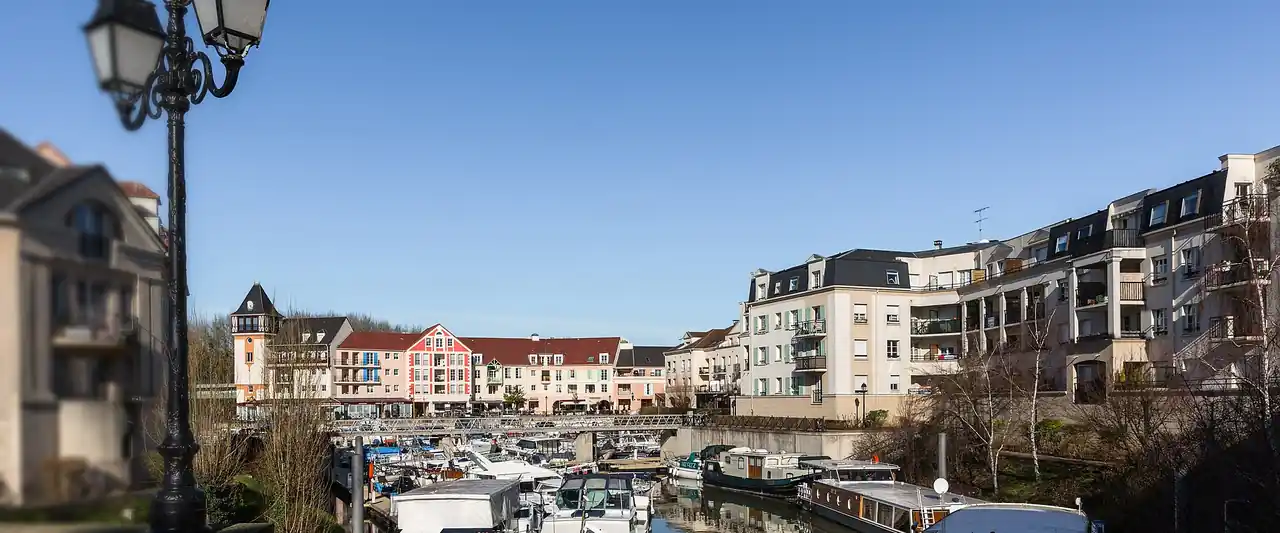
Photo: L. Pages - Ville de Cergy · CC BY-SA 4.0 (new tab) · Wikimedia Commons (new tab)
CEEVO and this site
What is CEEVO?
CEEVO (Comité d'Expansion Économique du Val-d'Oise) is the development and attractiveness agency of the Val-d'Oise. It supports companies in their plans to set up and publishes on this site the département's premises and land exchange.
Who is this site for?
For project owners, French or foreign, looking for offices, a business unit, a warehouse, a shop or land in the Val-d'Oise, and for companies already established here. It brings together the offers, the official figures of the area, the procedures, the grants and the contacts.
Do the site and CEEVO's services cost anything?
No: browsing the offers, creating an account and being supported by CEEVO are free. Only CEEVO's company files are sold, on an order form.
How do I contact CEEVO?
Through the form on the Contact page, by phone on +33 1 34 25 32 42 or by email at ceevo@ceevo95.fr, from Monday to Friday. The address is 2 avenue du Parc, 95000 Cergy, near the Cergy-Préfecture station (RER A, train line L).
Who publishes the premises offers?
Partner agents: networks, private agents, local authorities, developers and property promoters. The Partner agents page lists them; the advertiser's contact details appear on the full listing, reserved for registered users.
How can I get a quick answer on the site?
The “Ask a question” module searches the pages of the site for the passages closest to your question and returns them as they are, each with a link to its section. It writes nothing itself: if no passage clearly answers, it offers CEEVO's contact details.
Premises and land offers
What types of property can I find on the site?
Offices, business units and workshops, warehouses and logistics premises, shops, land and other property, to rent or to buy. 543 offers are published today.
How do I search for an offer?
On the Offers page, enter a town or a free search, then refine by type of property, rent or sale, surface area, budget (maximum rent or sale price), town, inter-municipal body or canton. You can also limit the search to a car travel time (10, 20, 30 or 45 minutes) from an arrival point: airport, station, prefecture, town or address. The calculation covers car travel only.
Can I search on a map?
Yes. The Offers page shows the offers on a map, with the “Search this area” option. The economic map goes further: jobs, businesses, fibre, business parks, stations and other layers, which you switch on one by one.
What can I see without an account, and with one?
Without an account, the list shows what the catalogue card displays: type of property, transaction, town, surface area, price and photo. With a free account, the full listing gives the address, surface areas, financial terms, technical characteristics, description and the agent's direct contact details, as well as the PDF sheets of offers and towns.
What does “Consult the agency” or “price on request” mean?
The agent has not published a price: contact them, their details are on the full listing. When you enter a budget in the search, offers with a price on request are excluded from the results.
How do I compare several offers?
Choose “Compare” on up to three offers: the comparison tool places them side by side. The comparison page can be shared by link and downloaded as a PDF.
Are the offers shown up to date?
Only published offers are shown: an archived or withdrawn offer is never displayed. Each offer is kept up to date by its agent and the listing shows its update date. To check that a property is still available, contact the advertiser directly.
I cannot find the property I need: what can I do?
Describe your need to CEEVO through the Contact page or by arranging a meeting. For a surface area that is not among the published large plots, the project form is sent to CEEVO. You can also create an alert to be notified of new offers.
Accounts, selection and alerts
Do I need an account, and is it free?
Searching and browsing the offers needs no account. The visitor account is free: first name, last name, company, email address and a password of at least 8 characters; an activation email confirms your address.
What is an account for?
To read the full listings of offers, obtain the agents' contact details and the PDF sheets, annotate your selection and create email alerts.
How does my selection of offers work?
On each offer, you can keep it in “My shortlist”. Without an account, the selection stays in your browser and the server keeps nothing. With an account, you find it again, annotate it, title it, reorder it and export it as CSV, Excel or PDF.
How do I create an alert for new offers?
Run a search in the catalogue, then choose “Receive new offers by email” (an account is required). You receive the new offers matching your criteria as soon as they appear (grouped mailings), once a day or once a week, depending on the frequency you choose.
How do I change, pause or delete an alert?
In your profile, the My alerts page lets you change the frequency, pause, reactivate or delete each alert. Each email also contains an unsubscribe link. A paused alert is deleted after a few weeks, and the alerts of an account inactive for 365 days are paused.
How do I retrieve or erase my account data?
From the My alerts page, you download your selection and your alerts (JSON file) or delete them. To exercise your other rights (access, rectification, erasure), write to CEEVO: the privacy policy gives the contact details of the data protection officer.
I forgot my password: what should I do?
On the login page, choose “Forgot your password?”: a reset link is sent to you by email.
What is the difference between a visitor account and a professional account?
The visitor account is for reading the full listings. The professional account is for agents and owners: it creates the company's page, checked by CEEVO and then displayed on the site, and allows you to publish your offers.
Grants, taxes and costs
What financial aid exists for setting up?
The Grants page presents, with a link to each official page: aid from the Île-de-France Region (for example PM'up, TP'up and Innov'up), Bpifrance financing, tax advantages depending on the location, research and innovation aid, hiring aid and honour loans. Amounts and conditions are those published on 2 October 2026: check them with the body concerned before any decision.
How do I find out a town's CFE and property tax rates?
The Grants, taxes, costs page shows the business property tax (CFE) rate and the land tax rate of each town, on a map and in a table; you enter your town there. The CFE is a local tax paid by businesses.
How much does it cost to set up?
The Set-up costs page gives benchmarks by town and type of property: local taxation, taxes specific to Île-de-France, labour costs, business property (asking prices of the site's listings), energy and networks, and what can reduce the cost.
Which taxes are specific to Île-de-France?
Two taxes target business premises: the tax on the creation of offices, shops and warehouses, paid only once on construction, reconstruction or extension, and the annual tax on offices, from which offices under 100 m², shops under 2,500 m² and storage premises under 5,000 m² are notably exempt. The 2026 rates are on the Procedures page.
Procedures and permits
What procedures are needed to set up?
The Procedures page describes fourteen steps in three stages: setting up the company (legal form, online declaration, registration, beneficial owners), moving into your premises (lease, planning, rules specific to Île-de-France, public-access buildings, classified installations, signage, electricity), then hiring and filing (hiring, taxes, e-invoicing). Each step names the competent body.
Where do I declare the creation of my company?
Online on the one-stop shop for business formalities (formalites.entreprises.gouv.fr), which is mandatory and run by the INPI. The company is then registered in the trade and companies register; the registry of the Pontoise commercial court is the contact indicated for the Val-d'Oise.
Which type of lease should I choose for my premises?
The commercial lease lasts at least 9 years; the tenant may terminate it at the end of each 3-year period and is entitled to renewal or, failing that, to an compensation for eviction. The professional lease lasts at least 6 years and is terminated with 6 months' notice.
Do I need a building permit?
A building permit is needed to build a building of more than 20 m² or carry out major works. Lighter works and a change of use of premises require a prior declaration. In both cases, the competent body is the town hall of the town where you set up.
Is an approval required in Île-de-France?
For some projects, yes: the business property approval is applied for online with the DRIEAT Île-de-France, which replies within 3 months, failing which it is deemed granted. Offices and technical premises under 1,000 m² are exempt, as are warehouses and industrial premises with no designated user under 5,000 m².
Is my activity a classified installation (ICPE)?
Installations classified for environmental protection fall under three regimes: declaration, registration or authorisation. In Île-de-France, the service to contact is the DRIEAT, which has a departmental unit in the Val-d'Oise.
How do I hire my first employee?
Send the prior notice of hiring (DPAE) to the Urssaf before the start date, at the earliest 8 days before the hire. The single personnel register is mandatory from the first employee, and an information and prevention visit follows the start of work.
What does e-invoicing change?
Since 1 September 2026, all companies must be able to receive electronic invoices through an approved platform. The obligation to issue them has applied since that date to large companies and mid-sized companies, and from 1 September 2027 to SMEs and micro-enterprises.
Which permits are needed for a major project?
The Procedures page offers a “major project” route: land and planning documents, environmental assessment and public consultation, environmental permits, development and building permits, taxes, steps after the permit, with the authority that decides in the general case. This list is not exhaustive and does not replace the analysis of your project by the authorities who process it.
Land, business parks and towns
Where can I find large plots of land?
The Land and business parks page presents, by size, the plots of one hectare or more, for sale or to let, published on the site. For a surface area that is not listed, describe your need through the project form, which is sent to CEEVO.
How do I find a business park?
The same page lists the département's business parks: map, key figures, list by inter-municipal body and your town's data. Reception venues, offices and shared workspaces, also let you start quickly.
How do I compare towns and inter-municipal bodies?
Each of the 183 towns presented has its own page (key figures, available offers, elected officials), and a tool compares several towns side by side. The urban and rural communities exercise the economic development competence and manage the business parks; their page presents member towns and key figures. The town hall receives and issues planning permits.
Which major projects and sectors are presented?
The Major projects page gathers official figures for leisure parks and large facilities, logistics, hotels and business tourism, data centres and the digital industry, with a confidential form to describe your project.
Can I find out about the risks and environment of an address?
The Ecology and transition page explains how to find out the risks of an address and presents natural areas, renewable energy, heat networks, water and air quality, and transition support.
Access, energy and digital
How do I get to the Val-d'Oise?
By road, train, RER, tram, air and river: the Access, digital, energy page details each mode, commuting journeys and the upcoming major public projects, with their date and source. Part of the Paris-Charles de Gaulle platform, the busiest airport in mainland France by passenger numbers, is in Roissy-en-France and Épiais-lès-Louvres, in the Val-d'Oise.
What coverage is there for fibre, 4G, 5G and electricity?
The Access, digital, energy page offers a map by town for optical fibre, 4G and 5G mobile coverage, electricity, heat, cooling and gas, with the method and sources. You enter your town there to see it at a glance.
Jobs, training and living locally
What workforce is available in the Val-d'Oise?
According to Insee (2023 census), the département has 622,025 people aged 15 to 64 in the labour force and 437,261 jobs, with 36.6% holding a higher-education degree. The Hiring and jobs page details qualifications, employing sectors and the trend in private-sector employment.
Where can I find help to recruit and train?
The Hiring and jobs page presents your contacts for recruiting and the directory of companies. The Training page lists the upper secondary schools, vocational courses, apprenticeship training centres, the school-business office and continuing training for your staff.
Can I work with universities and laboratories?
Yes. The Higher education and research page presents the institutions, fields of study, doctoral schools and research structures on the map, and explains how to recruit, host a work-study student, pay the apprenticeship tax or work with a laboratory. The département has 40,142 students (start of the 2024 academic year).
How do I house and settle my staff?
The Living locally page gathers, for your town, housing indicators, health, travel, culture, sport, safety and children's schooling (schools, international sections), as well as the procedures for settling an employee coming from abroad.
Foreign investors and companies
I am a foreign company: where do I start?
With the Coming from abroad page. It explains how to establish yourself in France, which rules apply and which public bodies support you free of charge (Business France, Choose Paris Region), with the investor guide to download (PDF, in English) and a page for each country of origin.
Which form of establishment should I choose in France?
Three main forms: the liaison office (no legal personality or commercial activity), the branch (a permanent establishment of the parent company, taxed in France) and the subsidiary (a separate French company, the most structured form). The comparison table, based on Business France, is on the Coming from abroad page.
Does a foreign investment need to be authorised?
Prior authorisation is required when three conditions are met: the origin of the investment, the nature of the transaction and the nature of the target company's activity. The administration replies within thirty working days of receiving a complete file, and a further review of 45 working days may follow; with no reply, the request is deemed rejected.
Which residence permits for my executives and employees?
The multi-year “talent” residence permit, valid for a maximum of 4 years, covers in particular skilled employees or employees on assignment within a group, corporate officers and investors. The visa application is filed with the French consular authorities of the country of residence; the conditions of three permits are detailed on the page.
Is there a page for my country of origin?
The site has a page for each investor country of origin (Germany, United States, United Kingdom, Japan, China, India, South Korea, Canada, Brazil and others). Each presents the official bodies that support companies from that country in France. The search field accepts the country name in any language.
CEEVO support
What does CEEVO do to support my project?
It listens to your project, points you to the premises and land offers, puts you in touch with local authorities, State services and network operators, and runs the network of the département's economic players. The Our support page describes the four steps.
How do I book a meeting with CEEVO?
Use the “Book a meeting with CEEVO” button: you give the subject, a weekday and a time of day (morning or afternoon), and CEEVO contacts you back to confirm the slot. There is no online calendar. You can also call +33 1 34 25 32 42.
My project is confidential: what happens to my request?
The project form on the Major projects page sends your description by email to CEEVO's contact mailbox, the only recipient. It is neither published nor stored in the site's database, and the technical log keeps nothing of it.
Which other bodies can I turn to?
The Your contacts page gathers public bodies (Département, prefecture, chamber of commerce, chamber of trades, Region, attractiveness agencies), the elected officials of each town, the cantons and a directory of legal, accounting and industrial property professionals. The company directory and the Who's Who show who is already established here.
How can I follow the département's economic news?
The News page publishes news from CEEVO, the Val-d'Oise economy, set-ups and projects, institutions and administrations. It is also available as an RSS feed, and the videos have their own page.
Is there a newsletter?
A sign-up with double confirmation is offered on the Your contacts page. As of 6 October 2026, sending has not yet started: your registration is recorded, and the confirmation email is sent to you when the newsletter opens. Without your confirmation, nothing is sent.
Data, languages and privacy
Where do the site's figures come from?
From official sources (for example Insee, the Urssaf, the DGAC, ministries and State services), cited under each block with their date. Always quote a figure with its date and source. Rules and amounts are valid as of the review date shown: check them with the competent body.
Can I download or reuse the data?
Several pages offer downloads: the key figures PDF, the CSV exports of the company directory, the export of your selection of offers (CSV, Excel, PDF) and the investor guide. Photographs carry their credit and licence beneath the image.
Does CEEVO sell company files?
Yes: the online order form offers the directory of Val-d'Oise companies and a file of importing and exporting companies. There is no online payment: payment is by cheque made out to CEEVO, enclosed with the order, and only orders accompanied by their payment are processed.
Some information is wrong or incomplete: how do I correct it?
On the pages of towns, inter-municipal bodies, partner agents, key people, companies and institutions, the “Update this page” link lets you propose a photo, a logo or corrections. CEEVO validates before any publication: nothing is published when you send it.
Which languages is the site available in?
In 20 languages: French, English, German, Italian, Japanese, Ukrainian, Spanish, Dutch, Simplified Chinese, Portuguese, Finnish, Polish, Czech, Swedish, Danish, Norwegian, Korean, Turkish, Arabic and Hindi. The language selector is at the bottom of every page. The full text is written in French and English; some passages, such as official sheets or the regulatory texts cited, may remain in their original language.
How is my personal data protected?
CEEVO sells no data. The contact and project forms are sent by email to CEEVO without being stored in the site's database; an account keeps the information it needs to work. Your rights of access, rectification, erasure, restriction and objection are exercised with the data protection officer, and you may refer the matter to the CNIL.
Which cookies does the site use?
The Cookies and trackers page lists each cookie, its purpose, its lifetime and when it is set.
Is the site accessible to people with disabilities?
The Accessibility page publishes the accessibility statement, the multi-year plan and the action plan, with the site's compliance status, which the footer repeats. If content is not accessible, you can contact CEEVO to be directed to an alternative or to obtain it in another form.
Answers written from the pages of the site, reviewed on Oct. 6, 2026.
Your question is not in the list?
Describe your project to CEEVO: it replies from Monday to Friday and points you to the right contacts.